

Diamond Stud Earrings Decoded: The Insider Secrets Jewelers Hope You Never Discover (Before You Spend a Cent)

Diamond studs are the most-worn fine jewelry on the planet — and also the most overpriced when you don't know what you're doing. This is the no-fluff, expert-distilled buyer's playbook that combines insights from GIA, Whiteflash, and seven other leading sources into one definitive guide. Read this before you buy, and you'll outsmart 90% of shoppers (and most sales associates).
Why Diamond Studs Are Still the Smartest Jewelry Purchase You'll Ever Make
From ancient Egyptian ear ornaments to Meghan Markle's wedding-day Cartier studs, the diamond stud has survived 5,000 years of changing fashion for one reason: it works with everything. Casual, formal, gym, gala — these earrings flex. They're the rare piece of jewelry many women genuinely never take off, which means cost-per-wear is microscopic compared to anything else in your jewelry box.
But that "wear them forever" longevity is also why a hasty purchase haunts you. Choose wrong on cut quality or backing security, and you'll either stare at dull pebbles for a decade or lose one in a scarf within months. Let's make sure neither happens.
The 4Cs — But Re-Ranked Specifically for Studs (This Changes Everything)
Here's the secret the engagement-ring industrial complex doesn't broadcast: the 4Cs are not equally important for stud earrings. Because studs are viewed from arm's length — not under a 10x loupe across a candlelit table — you can dramatically reprioritize. Use this hierarchy to redirect spend where it visibly counts.
1. Cut — The Only "C" You Cannot Compromise
Cut governs how a diamond returns light. A poorly cut 1-carat stone looks smaller, darker and deader than a brilliantly cut 0.75-carat one. For studs, the entire visual payoff is sparkle from a distance — so target Excellent or Very Good cut grades only. Ideal/Super-Ideal is even better if budget allows.
2. Carat Weight — Beware the Doubling Trap
This is the single most common rip-off in stud buying. "Total carat weight" (TCW or CT TW) is the combined weight of both earrings. A "1 ct TW" pair has two 0.50 ct diamonds — not two 1-carat stones. Always confirm whether you're looking at total weight or per-earring weight before comparing prices.
- Everyday wear sweet spot: 0.25 – 1.00 ct TW (roughly 0.12 – 0.50 ct per ear)
- Evening / statement size: 1.25 – 2.00 ct TW (0.60 – 1.00 ct per ear)
- Pro tip: Buy a few points under magic sizes (0.48 ct instead of 0.50 ct) — visually identical, often 10–15% cheaper.
3. Color — The Smartest Place to Save
Diamond facets mirror their surroundings. Once mounted, your studs pick up the tone of your skin, hair and the setting metal — making true colorlessness mostly invisible at conversational distance. The consensus across GIA, Whiteflash and All Diamond:
- G–H = the sweet spot. Looks colorless to the naked eye, costs far less than D–F.
- I–J = excellent value, especially set in yellow or rose gold.
- K and below = harmonizes with yellow gold; avoid in white settings.
4. Clarity — The Other Big Saving Opportunity
Per GIA's own guidance, you can confidently go as low as SI1, SI2, or even I1 for studs, provided the inclusions aren't visible face-up. Save your clarity budget — nobody is examining your earlobes with a loupe.
Diamond Shapes: Match the Cut to Your Face and Lifestyle
Different shapes flatter different faces, and yes — geometry actually changes how big a diamond looks at the same carat weight.
| Shape | Vibe | Best For | Watch Out |
|---|---|---|---|
| Round Brilliant | Classic, max sparkle | Any face shape, daily wear | Looks smaller per carat than fancy shapes |
| Princess | Modern, geometric | Slim/oval faces, edgy looks | Sharp corners need protective prongs |
| Cushion | Romantic, soft square | All faces, vintage lovers | Slightly less brilliance than round |
| Oval / Marquise | Elongating, elegant | Round / broad faces | Bow-tie effect if poorly cut |
| Emerald / Asscher | Sophisticated, refined | Showcasing clarity | Less fire — needs high clarity |
| Pear | Distinctive, vintage | Statement pieces | Harder to match as a pair |
Settings Explained: The 3 Styles That Actually Matter
Martini Setting (V-shaped cone)
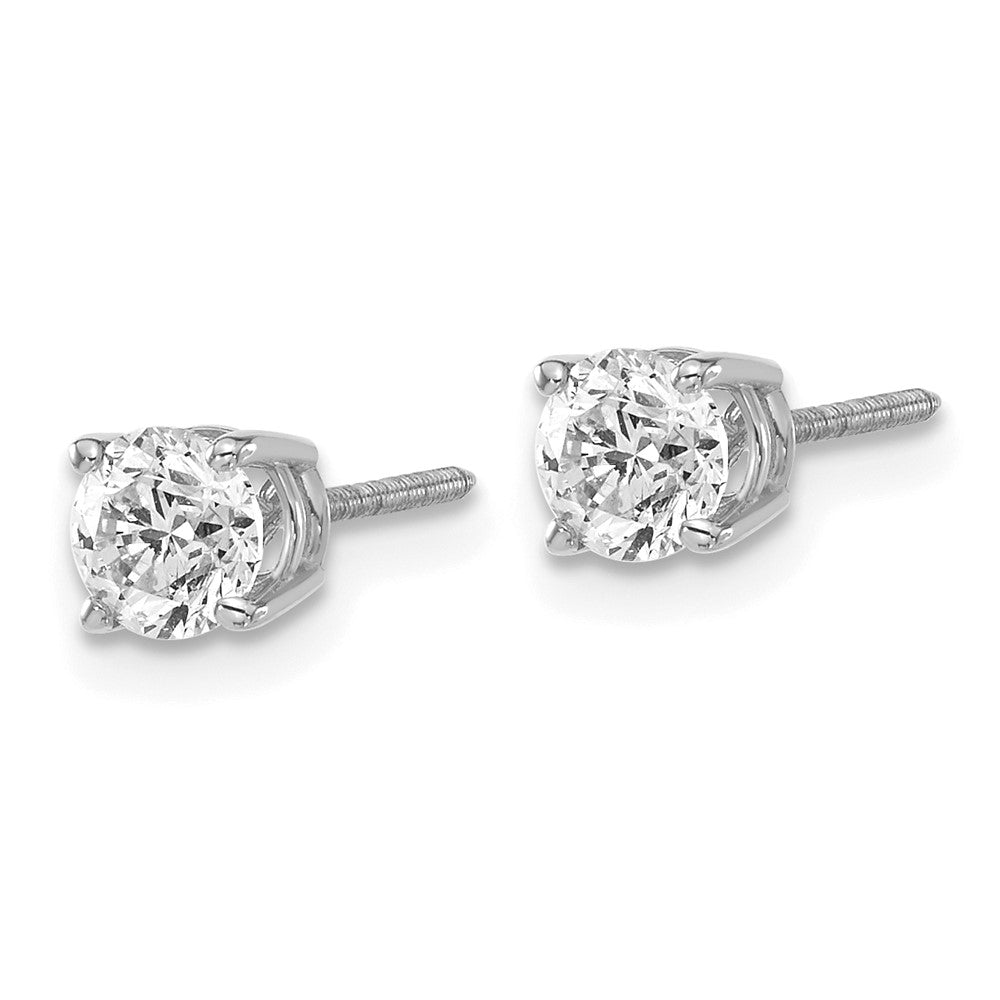
The most popular style for one reason: it sits close to the ear and never droops. The diamond is held by three or four prongs in a cone that resembles a martini glass from the side. Maximum visible diamond, minimum metal.
Pros
- Sits flush against the lobe
- Maximum sparkle and light entry
- Excellent for larger stones
Cons
- Cone can dig into thin earlobes
- Prongs need periodic tightening
Basket Setting (flat-bottomed cradle)
The diamond sits in a flat-base "basket" of prongs slightly farther from the ear. Great alternative for anyone whose ears find martini settings uncomfortable.
Pros
- Gentler on the earlobe
- Still highly brilliant
- Classic, timeless silhouette
Cons
- Slightly more prone to drooping
- Marginally less light return than martini
Bezel Setting (metal-wrapped)
A thin metal rim fully or partially surrounds the diamond. The safest choice for active wearers — gym-goers, parents of toddlers, anyone who sleeps in their earrings.
Pros
- Outstanding security — nearly impossible to lose
- Protects the diamond's edges
- Sleek, modern silhouette
Cons
- Less of the diamond is visible
- Light entry is reduced — slightly less sparkle
Metal Choice: Match to Skin, Lifestyle and Diamond Color
| Metal | Best Diamond Color | Skin Tone | Durability | Maintenance |
|---|---|---|---|---|
| Platinum | D–J (colorless) | Cool / sensitive skin | ★★★★★ Hypoallergenic | Polish occasionally |
| White Gold (14K / 18K) | D–J (colorless) | Cool / fair | ★★★★ Coated in rhodium | Re-plate every 1–3 yrs |
| Yellow Gold | K–Z (masks tint) | Warm undertones | ★★★ Softer alloy | Low — polish as needed |
| Rose Gold | Any (universal flatter) | All tones, neutral | ★★★★ Copper-strengthened | Low — hides scratches |
Earring Backs: The $5 Component That Saves Thousands
This is where buyers get sloppy and lose diamonds. The back is not an afterthought — it's the difference between a lifetime heirloom and an expensive shower-drain accident.
- Screw backs: Maximum security. Best for high-value diamonds and sleepers. Slightly thicker post can feel less comfortable.
- Locking backs (e.g., La Pousette): Spring-loaded mechanism — top-tier security with easy on/off.
- Push/friction backs: Convenient and comfortable but the lowest security tier. Use only for smaller, lighter studs.
- Back size matters: Larger studs need larger backs — small backs cause heavy earrings to droop forward.
Natural vs Lab-Grown: A Practical Breakdown
Lab-grown diamonds are chemically, optically and physically identical to mined diamonds and typically cost 40–70% less per carat. For studs — where resale value matters less than visible sparkle — lab-grown gives you significantly more size and quality for your budget. Just insist on IGI or GIA certification confirming origin and grades.
How Much Should You Actually Spend?
The honest range is $100 to $30,000+. A reasonable starting budget for a genuine pair of well-cut studs from a reputable jeweler:
- $300 – $800: 0.25–0.40 ct TW, lab-grown or natural with G–H/SI1
- $800 – $2,000: 0.50–0.75 ct TW, well-cut natural diamonds
- $2,000 – $5,000: 1.00 ct TW, GIA-certified, Excellent cut, G/SI1
- $5,000+: 1.50–2.00 ct TW or higher, premium colorless/eye-clean specifications
The Mobile-Friendly Master Summary Table
| Decision | Recommended Choice | Why It Matters |
|---|---|---|
| Cut Grade | Excellent / Very Good | Drives sparkle — never compromise |
| Color | G – H | Looks colorless, saves 30–40% |
| Clarity | SI1 – SI2 | Eye-clean at viewing distance |
| Carat (daily) | 0.50 – 1.00 ct TW | Visible without overwhelming |
| Carat (evening) | 1.25 – 2.00 ct TW | Photographs and presence |
| Shape | Round brilliant | Most sparkle, universal flatter |
| Setting (style) | Martini, 4-prong | Sparkle + flush-to-ear fit |
| Setting (active) | Bezel | Maximum security |
| Metal (sensitive skin) | Platinum | Hypoallergenic, durable |
| Metal (best value) | 14K white gold | Durable, affordable, bright |
| Backing | Screw or locking | Prevents loss |
| Certification | GIA or IGI | Verifies what you're paying for |
| Origin | Lab-grown for value, natural for tradition | Identical look, different price |
The 7 Mistakes That Ruin Most Stud Purchases
- Confusing total weight with per-stone weight. Always clarify.
- Buying based on size alone. A dull large diamond looks worse than a brilliant smaller one.
- Skipping certification. No GIA/IGI report = no real way to verify what you bought.
- Ignoring the backing. Push backs on $5,000 studs is a recipe for grief.
- Overpaying for clarity and color. SI1 and G–H are visually indistinguishable from VVS1 and D in stud form.
- Not asking about pair matching. The two diamonds must match in cut, color, clarity and size.
- No upgrade or return policy. Reputable jewelers offer trade-up programs and full returns — insist on both.
Care Habits That Keep Studs Sparkling for Decades
- Put earrings on last (after perfume, hairspray, lotion) and take them off first.
- Soak monthly in warm water with a drop of mild dish soap; brush gently with a soft toothbrush.
- Never wear in pools or hot tubs — chlorine attacks alloys.
- Professional inspection and prong check every 6–12 months.
- Store each pair in a separate soft pouch or fabric-lined box compartment.
FAQ — Real Questions Real Buyers Ask
Are 2-carat diamond studs too big for daily wear?
For most ear sizes, 2 ct TW (1 ct per ear) is the upper limit of comfortable daily wear. They make a statement without overwhelming the lobe — provided your setting is secure and well-balanced.
Can I sleep in diamond stud earrings?
Technically yes, especially with screw backs and bezel settings. But to extend prong life and reduce snagging, removing them at night is wiser.
Do lab-grown diamonds sparkle the same?
Identically. They have the same refractive index, hardness and fire as mined diamonds — they're chemically the same material.
How do I verify the diamonds match?
Request side-by-side high-definition imaging and ensure both diamonds carry separate grading reports with comparable cut, color, clarity and carat data.
The Final Word
Buying diamond stud earrings becomes simple once you stop chasing carat numbers and start chasing brilliance. Prioritize cut, accept smart compromises on color and clarity, demand a certified report, choose a secure setting that fits your real life — and you'll walk away with a pair that outshines studs twice the price. The best diamond studs aren't the biggest. They're the ones you never want to take off.

 Contact Us