

What Size Diamond Stud Earrings Look Best? The Brutally Honest Guide Jewelers Won't Tell You

Buying diamond studs without knowing the right size is the fastest way to waste hundreds (or thousands) on a pair you'll never wear. Too small and they vanish on your ear. Too big and they tug, droop, and scream "trying too hard." This guide breaks down the exact carat-to-millimeter math, the secret face-shape rules, the lifestyle filters, and the size sweet spot 80% of buyers actually love — so you get it right the first time.
The Short Answer: The Sweet Spot Most People Love
If you only read one paragraph, read this one. For everyday wear, the universally flattering range is 0.50 to 1.00 carat total weight (CTW) — meaning 0.25 to 0.50 carats per ear, or roughly 4.1 mm to 5.2 mm in diameter for round brilliants. This range reads as elegant and visible without overwhelming your face, snagging on hair, or sitting heavy on the lobe. It also flatters almost every face shape and dresses up or down effortlessly.
If you want a stronger statement that you can still wear daily, push to 1.50 CTW (0.75 ct each, ~5.8 mm). For purely formal or evening wear, 2.00 CTW and above becomes your territory.
Carat-to-Millimeter Cheat Sheet (Save This)
Here's the chart that actually matters. Jewelers sell by carat, but your ear sees millimeters. Reference this every time you shop.
| Total CTW | Per Ear | Diameter | The Vibe | Best For |
|---|---|---|---|---|
| 0.25 CTW | 0.125 ct | ~3.0 mm | Whisper-quiet | Second piercings, teens, sleepers |
| 0.50 CTW | 0.25 ct | ~4.1 mm | Polished & subtle | Office, daily wear, small lobes |
| 1.00 CTW | 0.50 ct | ~5.2 mm | Classic & versatile | Most face shapes, all occasions |
| 1.50 CTW | 0.75 ct | ~5.8 mm | Confident statement | Bold daily wear, gifts |
| 2.00 CTW | 1.00 ct | ~6.5 mm | Glamorous & noticeable | Formal events, upgrades |
| 3.00 CTW+ | 1.50 ct+ | ~7.4 mm+ | Red-carpet drama | Special occasions only |
Match the Size to Your Face Shape (This Changes Everything)
Sizing isn't just personal preference — proportion is real. The same 1-carat stud can look perfect on one person and undersized on another. Use your face shape as the deciding tiebreaker.
Round Face
Slightly larger studs (0.75 to 2.00 CTW) help elongate softer features. Elongated cuts like oval, pear, or marquise add subtle vertical lines that flatter a rounded jawline.
Oval Face
You won the lottery — almost any size works. The classic 0.50 to 1.00 ct per ear range looks naturally balanced. Round, princess, and cushion cuts all flatter.
Square Face
Soften strong angles with medium-to-large studs (1.00 to 2.00 CTW) in round, oval, or cushion cuts. Avoid sharp princess cuts, which can emphasize jawline angles.
Heart-Shaped Face
Medium-to-large studs balance a wider forehead with a narrower chin. Teardrop or pear shapes pointing downward add visual weight where you need it.
Diamond / Angular Face
Stick with 0.50 to 1.50 CTW in curved shapes (round, cushion, oval) to soften sharp cheekbones. Avoid anything too pointy or geometric.
Match the Size to Your Lifestyle
Carat weight is half the equation. The other half is how you actually live. Be honest with yourself here — buying a 3-carat pair you only wear twice a year is a far worse investment than a 1-carat pair you wear daily for decades.
The Minimalist or Active Wearer
If you sleep in your studs, run, lift weights, wear headphones, or chase toddlers, stick with 0.25 to 0.50 CTW. Smaller stones sit close to the lobe, resist snagging, and don't tilt forward under their own weight.
The Everyday Professional
The corporate uniform of choice is 0.50 to 1.00 CTW. Visible across a conference table, refined enough for Zoom, and never inappropriate for a dinner reservation.
The Statement Lover
If you reach for fewer-but-bolder pieces, 1.50 to 2.00+ CTW rewards you with sparkle that's the focal point of every outfit. Just commit to screw backs.
Age Guidelines: What's Appropriate at Every Stage
While age is no rule, there are sensible benchmarks. Infants and toddlers should wear tiny 3 mm studs with locking backs. Young children and pre-teens look balanced in 4–5 mm studs. Teenagers typically transition into 0.25–0.75 CTW. Adults have full range, from delicate 0.50 CTW for daily refinement to 2.00+ CTW for statement wear. The general principle: studs should never overwhelm the ear they sit on.
Pros & Cons of Each Popular Size
0.50 CTW Studs
Pros
- Light, comfortable, snag-free
- Affordable entry point
- Works for any age or face shape
- Safe with simple push backs
Cons
- Easy to miss from a distance
- Less impact in formal settings
- May look undersized on larger faces
1.00 CTW Studs (The Crowd Favorite)
Pros
- Universally flattering size
- Visible sparkle without heaviness
- Dresses up or down
- The most popular gifting size
Cons
- Price jumps sharply versus 0.50 CTW
- Push backs may loosen over time
- Quality matching adds cost
2.00 CTW Studs
Pros
- Bold, luxurious sparkle
- Strong visual impact
- Excellent for formal wear
Cons
- Significantly more expensive
- Can droop without proper backs
- May feel heavy for daily wear
- Overwhelming on small lobes
The Setting Trick That Makes Diamonds Look Bigger
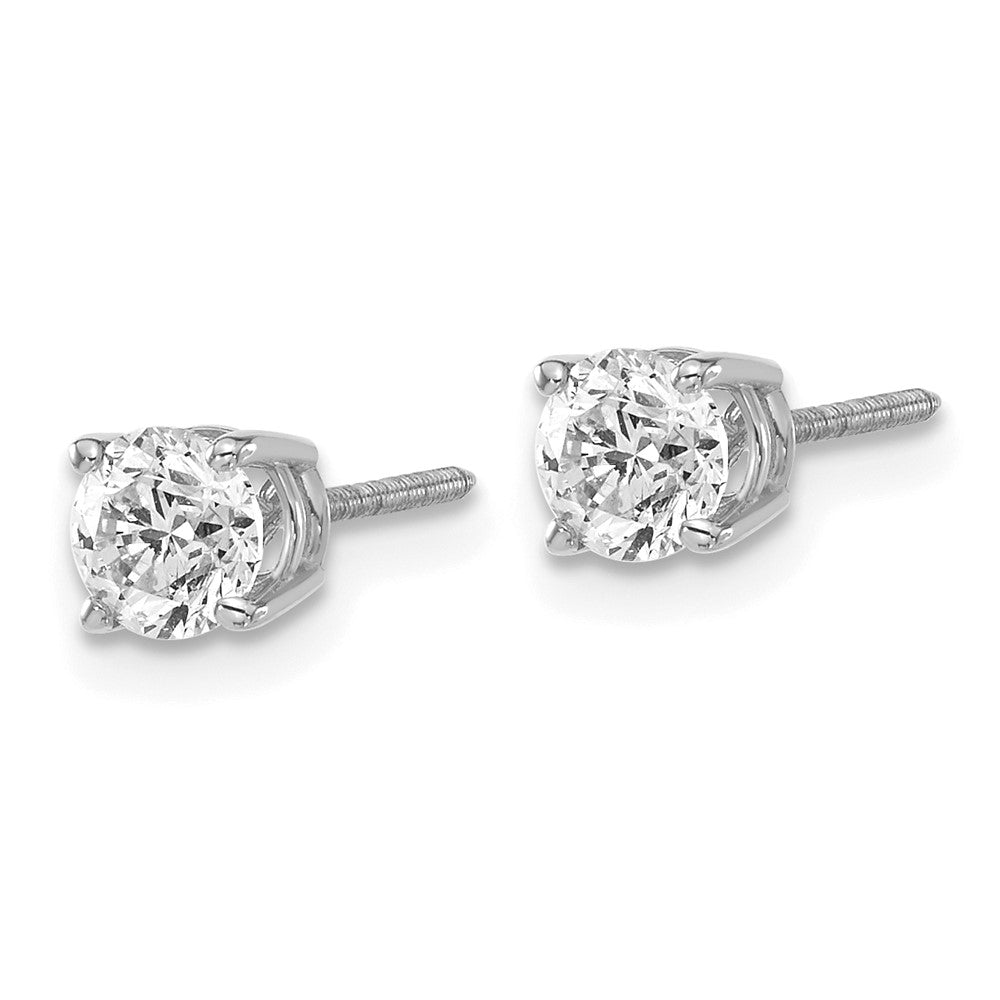
This is the insider secret most buyers miss: the setting changes perceived size more than a tenth of a carat does. A four-prong or martini setting exposes maximum diamond surface — making the stone look as large as possible. A halo setting wraps tiny accent diamonds around the center stone, instantly making a 0.50 ct look closer to 0.75 ct. Bezel settings, while supremely secure for active wearers, hide a millimeter of perimeter and read slightly smaller.
Backings Matter More Than You Think
Once you go above 1.00 CTW, push backs become a liability. Screw backs and locking La Pousette backs are non-negotiable for keeping heavier studs upright and on your ear. They're slightly slower to put on, but losing a single diamond stud can cost hundreds to replace and ruins the pair. For studs under 0.75 CTW, friction backs paired with a properly sized back disc are usually sufficient.
How Cut, Color & Clarity Affect "Best Size"
The 4Cs hierarchy for studs is different than for engagement rings, because studs are viewed from greater distances and aren't scrutinized up close. Prioritize in this order: Cut (always Excellent or Very Good — this drives sparkle and perceived size), Color (G–H in white metals is invisible to the eye and saves significantly), Clarity (SI1 or VS2 is eye-clean from earring distance). This strategy lets you size up roughly half a carat for the same budget.
Lab-Grown vs. Natural: Which Lets You Go Bigger?
This is where the math gets interesting. Lab-grown diamonds are chemically and visually identical to mined diamonds but cost 40–70% less. That means the budget for a natural 0.75 CTW pair will buy you a stunning 1.25 to 1.50 CTW pair in lab-grown — often with better color and clarity grades. If size and sparkle are your priorities, lab-grown is the smartest path to a bigger look. If rarity, resale value, or heirloom sentiment matter more, a smaller natural diamond carries traditional weight.
Budget Reality Check: What You'll Actually Pay
Diamond pricing is non-linear. A single 1.00 ct diamond doesn't cost twice as much as a 0.50 ct — it costs roughly three to four times more, because larger high-quality stones are exponentially rarer. Add the fact that earrings require a matched pair, and pricing climbs further. Expect ballpark ranges of $400–$900 for 0.50 CTW natural studs, $2,000–$4,000 for 1.00 CTW, and $7,000–$15,000+ for 2.00 CTW depending on quality. Lab-grown pricing is roughly half across the board.
When Are Diamond Studs Officially "Too Big"?
There's no universal limit, but most jewelers agree studs exceeding 2.00 to 3.00 carats each cross into territory where they tend to droop, draw constant attention, and look proportionally heavy on average earlobes. The honest test: if your stud extends below the bottom edge of your earlobe or tilts forward when you nod, it's too big for your ear. Studs should sit flat and centered, not pull or pivot.
Final Verdict: The Best Size for Most People
If you're shopping for your first serious pair of diamond studs, want something you'll genuinely wear every day, and want to balance budget with visible sparkle, target 1.00 CTW (0.50 ct per ear, ~5.2 mm diameter) in a four-prong setting with an Excellent cut grade, G–H color, and SI1–VS2 clarity. Add screw backs for security and choose lab-grown if maximizing size matters more than origin. This is the formula that satisfies more buyers than any other across every major jeweler's recommendation.
Quick FAQ
Is 1 carat too small for diamond studs?
No — 1 CTW (0.50 ct each) is the most popular size for a reason. It's visible, elegant, and flattering on virtually every face shape.
Are 2 carat studs too big for everyday wear?
For most people, no — but they require secure screw backs and feel heavier. They look more dramatic in casual settings, so if you prefer understated jewelry, stay at 1.00–1.50 CTW.
What size do most women wear?
0.50 to 1.00 CTW is the dominant range across nearly every jeweler's bestseller list.
Can I sleep in diamond studs?
Yes, if they're 0.50 CTW or smaller with low-profile settings and screw backs. Larger studs are best removed at night to avoid bending posts or loosening prongs.

 Contact Us